


Most people use the words compassion and empathy interchangeably. That is a mistake with real consequences. Understanding compassion vs empathy can change how you relate to others, protect your mental health, and even reshape the way your brain responds to suffering. Neuroscience research from the Max Planck Institute reveals that these two responses activate completely different neural networks. One can lead to burnout. The other builds resilience.
This article breaks down the five core differences between compassion vs empathy, explains the brain science behind each, and shows you how to shift from one to the other when it matters most.
What Is Empathy?
Empathy is the ability to feel what another person is feeling. When a friend shares painful news and your chest tightens in response, that is empathy at work. Your brain mirrors their emotional state as though you are experiencing it yourself.
There are two types. Cognitive empathy means you understand someone’s perspective intellectually. Emotional empathy means you physically feel their distress in your own body. Both play important roles in human connection, but emotional empathy in particular carries a hidden cost that most people overlook.
What Is Compassion?
Compassion goes beyond feeling someone’s pain. It includes the recognition of suffering combined with a deliberate desire to help. Where empathy says “I feel your pain,” compassion says “I see your pain and I want to help relieve it.”
The Latin root of compassion, compati, literally means “to suffer with.” However, compassion adds a critical element that empathy lacks: forward motion. It moves you from an emotional reaction toward a constructive response. This distinction is at the heart of the compassion vs empathy debate and has significant implications for caregivers, parents, leaders, and anyone who regularly supports others.
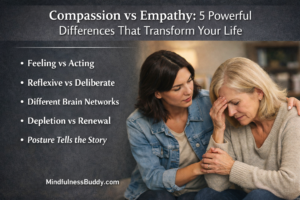
5 Key Differences Between Compassion vs Empathy
1. Feeling With vs Acting For
Empathy is a shared emotional experience. You absorb what someone else feels. Compassion takes that awareness and channels it into action. A nurse who feels overwhelmed after absorbing a patient’s grief is experiencing empathy. That same nurse finding words of comfort and coordinating better care is practicing compassion.
2. Reflexive vs Deliberate
Empathy often arises automatically. Mirror neurons fire before you have time to think. Compassion, on the other hand, is a conscious choice. You recognize suffering and intentionally decide to respond with care. This means compassion is a skill you can develop through practice, while empathy is largely a reflexive emotional response.
3. Different Brain Networks
This is where the science of compassion vs empathy becomes striking. Dr. Tania Singer at the Max Planck Institute used fMRI scanning to study both responses. Empathy activated the anterior insula and anterior midcingulate cortex, brain regions associated with pain processing. Compassion activated the ventral striatum, pregenual anterior cingulate cortex, and medial orbitofrontal cortex, regions linked to positive emotions, reward, and social connection. The two networks did not overlap at all (Klimecki, Leiberg, Ricard & Singer, 2014).
4. Depletion vs Renewal
One of the most important findings in the compassion vs empathy research is their opposite effect on wellbeing. Singer’s team found that empathy training increased negative affect among participants. They reported feeling more distressed and overwhelmed. However, when those same participants received compassion training afterward, negative emotions decreased and positive emotions increased. Compassion is a renewable resource. Empathy, left unchecked, drains you.
5. Posture Tells the Story
Singer’s research revealed a visible physical difference between the two states. During empathy exercises, participants hunched over in self-protective postures with pained facial expressions. When they shifted to compassion exercises, their posture straightened, their faces brightened, and they displayed greater confidence. Your body knows the difference between compassion vs empathy even before your conscious mind does.
Why the Distinction Matters for Burnout
What healthcare workers, therapists, and caregivers commonly call “compassion fatigue” is actually empathy fatigue. When you repeatedly absorb the suffering of others without shifting toward a compassionate response, emotional exhaustion follows. Singer’s neuroscience research reframes this entirely.
Compassion does not deplete you. It activates reward circuits that sustain motivation and wellbeing. Organizations that train employees in compassion rather than just empathy see meaningful reductions in burnout. The key is learning to recognize suffering without drowning in it, then directing your energy toward helpful action.
How to Shift From Empathy to Compassion
Understanding compassion vs empathy is valuable, but applying it daily is what creates lasting change. Here are four practical ways to make the shift.
Pause before absorbing. When someone shares their pain, take a breath before letting their emotions flood your system. Create a small space between their experience and your response.
Ask what would help. Instead of sitting in shared sadness, direct your attention toward what you can do. Even small actions like listening without judgment or offering a kind word activate the compassion network.
Practice loving-kindness meditation. Research from Singer’s lab confirms that meditation focused on warmth and care for others strengthens the compassion neural network over time. Even brief daily practice produces measurable changes in brain activity.
Protect your boundaries. Compassion includes self-awareness. Recognizing when you are slipping into empathic distress, and stepping back to recharge, is not selfish. It is what allows you to keep showing up for others sustainably.
Compassion vs Empathy in Everyday Relationships
The compassion vs empathy distinction is not limited to clinical settings. It shows up in friendships, parenting, and workplaces every day. A parent who absorbs their teenager’s anxiety may become anxious themselves, reducing their ability to help. A parent who recognizes the anxiety and responds with calm support practices compassion.
In the workplace, leaders who default to empathy risk emotional exhaustion. Leaders who practice compassion maintain clarity, make better decisions, and create psychologically safe teams. Understanding compassion vs empathy gives you a framework for being truly helpful without losing yourself in the process.
The Bottom Line
Compassion vs empathy is not about choosing one over the other. Both are essential parts of human connection. Empathy helps you recognize and relate to suffering. Compassion helps you do something about it without being consumed. The neuroscience is clear: compassion activates brain networks associated with positive emotions and resilience, while unchecked empathy activates pain networks that lead to distress.
Learning to notice empathy when it arises and intentionally shift toward compassion is one of the most valuable emotional skills you can develop. It protects your wellbeing, strengthens your relationships, and allows you to sustain care for others over the long term.