

Mindfulness for beginners can feel overwhelming at first. You might picture hours of silent meditation or imagine you need to empty your mind completely. The truth is far simpler and far more accessible than most people realize. Mindfulness is the practice of paying attention to the present moment without judgment, and anyone can start right now.
Millions of people around the world have discovered that even a few minutes of daily mindfulness practice can reduce anxiety, sharpen focus, and improve emotional well-being. You do not need special equipment, prior experience, or a spiritual background. All you need is the willingness to slow down and observe your own experience with curiosity and kindness.
Why Mindfulness for Beginners Deserves Your Attention
The growing body of scientific research behind mindfulness is impressive. Studies from major universities have shown that regular mindfulness practice physically changes the brain. Gray matter increases in areas associated with memory, empathy, and self-awareness, while the amygdala, the brain’s stress center, actually shrinks over time.
For anyone exploring mindfulness for beginners, this means the benefits are not just psychological. They are structural and measurable. A comprehensive review published by JAMA Internal Medicine found that meditation programs can meaningfully reduce symptoms of anxiety, depression, and chronic pain. These are not vague promises. They are peer-reviewed findings backed by rigorous methodology.
Beyond brain changes, mindfulness improves how you relate to your emotions. Instead of reacting impulsively to stress or frustration, you learn to pause and choose your response deliberately. This single shift can transform your relationships, your work performance, and your overall quality of life.
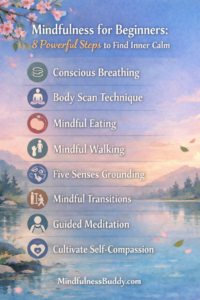
1. Begin With Conscious Breathing
The foundation of mindfulness for beginners is breath awareness. Find a comfortable seat, close your eyes, and direct your attention to the sensation of breathing. Notice the air entering your nostrils, the rise and fall of your chest, and the gentle expansion of your belly.
When your mind wanders, and it will, simply guide your attention back to the breath without criticizing yourself. This redirection is not a failure. It is the actual exercise. Each time you notice distraction and return to breathing, you strengthen your attention muscle. Start with just three minutes a day and gradually increase as it becomes more natural.
2. Practice the Body Scan Technique
A body scan is an excellent mindfulness for beginners exercise that builds awareness of physical sensations. Lie down or sit comfortably and mentally move your attention from the top of your head slowly down to the tips of your toes.
At each area, notice whatever you feel without trying to change it. You might discover tension in your shoulders, warmth in your hands, or tingling in your feet. The goal is observation, not correction. This practice teaches you to inhabit your body fully and recognize the physical signals that emotions create. Many people find that a nightly body scan dramatically improves their sleep quality.
3. Try Mindful Eating at One Meal
Most people eat on autopilot, scrolling through their phones or rushing between tasks. Mindful eating transforms a routine activity into a rich sensory experience. Choose one meal per day to eat without screens or distractions, and give your full attention to the food in front of you.
Notice the colors, textures, and aromas before your first bite. Chew slowly and observe the flavors as they develop. This approach to mindfulness for beginners is particularly effective because it attaches the practice to a habit you already have. You are not adding time to your day. You are simply changing how you use existing time.
4. Take a Mindful Walk Outside
Walking meditation is one of the most enjoyable entry points into mindfulness for beginners. Choose a quiet path and walk at a slower pace than usual. Focus your attention on the physical sensations of movement, the feeling of your feet contacting the ground, the rhythm of your stride, and the gentle swing of your arms.
Expand your awareness to include the sights, sounds, and smells around you. Listen to birdsong. Feel the temperature of the air on your skin. When thoughts about your to-do list arise, acknowledge them gently and return your focus to the act of walking. Even a ten-minute mindful walk during a lunch break can reset your entire afternoon.
5. Use the Five Senses Grounding Exercise
When stress spikes suddenly, the five senses technique offers a rapid way to return to the present moment. It is especially useful for mindfulness for beginners because it requires no preparation or special setting. Simply pause wherever you are and identify five things you can see, four things you can touch, three things you can hear, two things you can smell, and one thing you can taste.
This structured approach occupies your thinking mind with concrete observations and interrupts the cycle of anxious thoughts. You can practice this technique in a meeting, on public transit, or while waiting in line. It takes less than two minutes and works remarkably well.
6. Set Mindful Transitions Between Activities
One overlooked opportunity in mindfulness for beginners is the space between tasks. Most people rush from one activity to the next without pausing. Instead, create small moments of awareness during transitions. Before opening your laptop in the morning, take three conscious breaths. When you arrive home from work, stand at the doorway for a moment and notice how your body feels.
These micro-pauses prevent stress from accumulating throughout the day. They act as reset buttons that keep you grounded and present rather than operating on frantic autopilot from sunrise to bedtime. Over weeks of practice, these transitions become automatic anchors of calm.
7. Start a Short Guided Meditation Practice
Guided meditations are incredibly helpful for mindfulness for beginners because they remove the guesswork. A teacher’s voice walks you through each step, telling you where to place your attention and how to handle distractions. Many free apps and online platforms offer sessions as short as five minutes.
Choose a consistent time each day for your practice. Morning works well for many people because it sets a calm tone before the demands of the day begin. Evening sessions can help you decompress and transition into restful sleep. The format matters less than the consistency. Even five minutes daily outperforms thirty minutes once a week.
8. Cultivate Self-Compassion as You Learn
Perhaps the most important aspect of mindfulness for beginners is approaching the entire process with kindness toward yourself. You will get distracted. You will forget to practice some days. You will feel restless or bored during meditation. None of these experiences mean you are doing it wrong.
Self-compassion is not an optional add-on to mindfulness. It is a core component. Research shows that people who treat themselves with patience during the learning process are far more likely to maintain a lasting practice. Speak to yourself the way you would speak to a close friend who is trying something new. Encouragement works better than criticism every single time.
Building Your Mindfulness for Beginners Routine
The best approach to mindfulness for beginners is to start small and build gradually. Choose one or two techniques from this list and practice them consistently for two weeks before adding more. Track your experiences in a simple journal, noting what felt natural and what challenged you.
Pay attention to the subtle shifts that accumulate over time. You may notice that you respond to traffic jams with patience instead of rage. You might catch yourself savoring a conversation rather than planning what to say next. These quiet changes are evidence that your practice is working.
Mindfulness for beginners is not about achieving a perfectly still mind. It is about developing a friendlier, more curious relationship with your own experience. Every moment of awareness counts, no matter how brief. The journey begins with a single conscious breath, and the rewards grow with every step you take.