
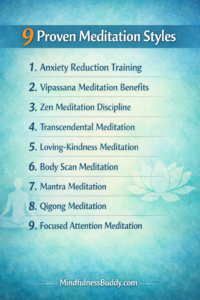
Choosing among the many meditation styles available today can feel overwhelming, especially for beginners. From ancient Buddhist traditions like Vipassana and Zen to modern clinical approaches like Mindfulness-Based Stress Reduction, each technique offers a unique path toward mental clarity, emotional balance, and physical well-being.
The good news is that research consistently shows meditation works. Studies published in journals like Clinical Psychology Review and the Journal of Consulting and Clinical Psychology confirm that regular practice reduces anxiety, improves focus, and strengthens emotional resilience. The key is finding the meditation styles that align with your personality, goals, and lifestyle. This guide breaks down nine of the most effective meditation styles backed by scientific evidence.
1. Mindfulness Meditation
Mindfulness meditation is the most widely practiced and researched form in the Western world. Rooted in Buddhist teachings, this technique asks you to observe your thoughts as they arise without judging or engaging with them. You simply notice patterns and gently return your attention to the present moment.
A landmark meta-analysis published by Johns Hopkins University researchers found that mindfulness programs produced moderate improvements in anxiety, depression, and pain. Most practitioners begin by focusing on their breath, then gradually expand awareness to include bodily sensations, sounds, and emotions. This style works well for people who want a straightforward, secular entry point into meditation.
2. Vipassana Meditation
Vipassana, which translates to “insight” or “clear seeing,” is one of the oldest meditation styles in the Buddhist tradition. Practitioners use deep concentration to examine specific aspects of human existence, including impermanence, suffering, and the nature of the self. Among all meditation styles rooted in ancient practice, Vipassana places the strongest emphasis on transformative insight rather than simple relaxation.
Traditionally taught during intensive 10-day silent retreats, Vipassana demands significant commitment. Practitioners sit for hours, systematically scanning bodily sensations and observing how they arise and pass away. Research classifies Vipassana as an “open monitoring” technique, associated with theta brainwave activity that supports problem-solving and emotional processing.
Zen Meditation (Zazen) Among the Most Disciplined Meditation Styles
Zen meditation, known as Zazen, originates from the Zen Buddhist tradition. Practitioners sit upright in a specific posture, follow the breath as it moves in and out of the belly, and allow the mind to simply exist. The aim is fostering presence and alertness without forcing any particular mental state.
A distinctive variant called Shikantaza, or “just sitting,” involves no specific object of focus at all. Instead, practitioners remain aware of everything passing through their minds without dwelling on anything. Zen is typically practiced in Buddhist centers called Sanghas, where community support and teacher guidance play central roles. This style suits people who value structure, discipline, and communal practice.
4. Transcendental Meditation
Transcendental Meditation, commonly known as TM, uses a personally assigned mantra repeated silently during two daily 20-minute sessions. Unlike concentration-based methods, TM encourages effortless repetition that allows the mind to settle naturally into quieter states of awareness. Researchers classify it as “automatic self-transcending,” associated with alpha brainwave patterns linked to relaxed wakefulness.
A meta-analysis reviewed by Psychology Today found that TM produced more than twice the improvement in reducing trait anxiety compared to other meditation styles studied. A separate 2018 study involving 60 participants in alcohol use disorder treatment found that TM practice was linked to lower stress, reduced cravings, and decreased alcohol use after three months.
5. Loving-Kindness Meditation (Metta)
Loving-Kindness Meditation, known as Metta Bhavana in Pali, focuses on cultivating unconditional compassion toward all beings. Practitioners silently repeat phrases like “may you be happy” and “may you be free from suffering,” directing these wishes first toward themselves, then loved ones, neutral acquaintances, difficult people, and finally all living creatures.
Research from the Greater Good Science Center at UC Berkeley shows that regular Metta practice increases positive emotions, improves social connectedness, and reduces self-criticism. A meta-analysis of 22 studies confirmed that this technique boosts compassion toward both oneself and others. Loving-Kindness is especially valuable for people dealing with interpersonal challenges, low self-esteem, or caregiver burnout.
6. Body Scan Meditation
Body scan meditation involves systematically directing attention to different parts of the body, noticing sensations, tension, or discomfort without trying to change anything. This technique is a core component of Mindfulness-Based Stress Reduction, the clinical program developed by Jon Kabat-Zinn in 1979, and serves as an accessible starting point among meditation styles for newcomers.
The closely related practice of Yoga Nidra, sometimes called “yogic sleep,” extends the body scan into a guided journey through progressively deeper states of conscious relaxation. Practitioners lie down in Shavasana while a teacher guides their awareness through each body region. Research suggests Yoga Nidra reduces symptoms of anxiety and depression while improving sleep quality. Both formats help people reconnect with physical sensations they may have been ignoring due to stress or chronic pain.
7. Mantra Meditation
Mantra meditation uses a repetitive sound, word, or phrase to anchor the mind. The Sanskrit syllable “Om” is perhaps the most recognized mantra, though practitioners may use any meaningful word. The rhythmic repetition creates a vibrational quality that many meditators find deeply calming and easier to sustain than breath-focused attention.
This approach is prominent in both Hindu and Buddhist traditions. In the Hindu practice of Japa, practitioners repeat a mantra using a string of prayer beads called a mala. Among popular meditation styles, mantra-based methods are particularly appealing to people who find silence uncomfortable or whose minds wander excessively during open awareness practices.
8. Qigong Meditation
Qigong is an ancient Chinese practice that combines breath awareness, gentle movement, and meditative focus to promote the healthy flow of vital energy known as Qi. The word Qigong literally translates to “working with Qi.” This practice shares similarities with Tai Chi but places greater emphasis on the meditative and healing dimensions of energy cultivation.
Practitioners perform slow, deliberate movements coordinated with deep breathing patterns. The goal is to harmonize body, mind, and spirit while building internal resilience. Qigong meditation styles appeal to people who prefer an active, embodied practice over seated stillness. Regular practitioners report improved balance, reduced chronic pain, and enhanced emotional stability.
9. Focused Attention Meditation
Focused attention meditation trains the mind to concentrate on a single object, which could be the breath, a candle flame, a sound, or any other sensory anchor. When the mind wanders, the practitioner gently redirects attention back to the chosen object. This process of noticing distraction and returning to focus is where the real training occurs.
Researchers associate this category with gamma brainwave activity, which typically appears during active information processing and learning. Samatha meditation from the Buddhist tradition and candlelight meditation are both popular forms of focused attention. Of all seated meditation styles, this technique is particularly helpful for people struggling with scattered attention, as the repeated practice of refocusing gradually strengthens concentration and mental discipline over time.
How to Choose Among These Meditation Styles
Selecting the right practice depends on your personal goals and temperament. If you want stress relief and emotional awareness, mindfulness or body scan meditation offers the most accessible starting point. If you seek deeper spiritual insight, Vipassana or Zen may resonate more strongly. Those who struggle with self-compassion should consider Loving-Kindness, while people who prefer physical engagement will likely enjoy Qigong.
The most important factor is consistency rather than perfection. Research across all meditation styles confirms that regular daily practice, even for just ten to fifteen minutes, produces meaningful benefits over time. Start with one technique, commit to it for at least 30 days, and pay attention to how your mind and body respond. You can always explore additional meditation styles later as your practice deepens and your understanding of what you need evolves.