


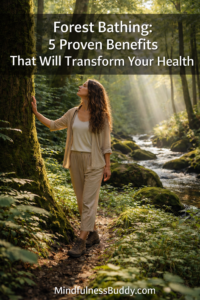
Forest bathing is the practice of immersing yourself in a woodland environment using all five senses to absorb the healing atmosphere around you. Known as shinrin-yoku in Japanese, this therapeutic approach was first introduced in 1982 when Tomohide Akiyama, then director of Japan’s Forestry Agency, coined the term to encourage citizens to use the nation’s vast woodlands for stress relief.
Since that initial naming, forest bathing has evolved from a cultural wellness tradition into a rigorously studied medical discipline. Researchers across Japan, South Korea, and Europe have published hundreds of peer-reviewed studies confirming its physiological and psychological benefits. Today, Japan maintains 65 certified Forest Therapy bases spread from Hokkaido to Okinawa, each evaluated by the Forest Therapy Society for environmental quality and therapeutic potential.
The Science Behind Forest Bathing
The scientific foundation of this practice rests largely on the pioneering work of two Japanese researchers. Dr. Qing Li, a clinical professor at Nippon Medical School in Tokyo and president of the Japanese Society of Forest Medicine, has spent over two decades studying how forest environments affect human immune function. His research established the field he calls Forest Medicine, an interdisciplinary science combining alternative, environmental, and preventive medicine.
Equally influential is Yoshifumi Miyazaki, emeritus professor at Chiba University’s Center for Environment, Health and Field Sciences. Miyazaki conducted the first physiological experiments on forest bathing in 1990 on Yakushima Island, measuring salivary cortisol levels among participants who walked through ancient cedar forests. His findings revealed that cortisol concentrations dropped significantly in the forest compared to a controlled laboratory setting.
1. Forest Bathing Strengthens Your Immune System
One of the most remarkable discoveries about shinrin-yoku involves its effect on natural killer cells, a type of white blood cell that plays a critical role in fighting infections and tumors. In a landmark study, Dr. Qing Li and his team at Nippon Medical School sent 12 healthy male subjects on a three-day trip through forest fields near Tokyo.
Blood samples taken during and after the trip showed that NK cell activity increased by approximately 50 percent compared to pre-trip levels. The researchers also found elevated levels of anti-cancer proteins including perforin, granulysin, and granzymes in the participants’ lymphocytes. A follow-up study with 13 female nurses produced similar results, and the immune boost persisted for more than seven days after the trip ended.
Dr. Li attributed these effects partly to phytoncides, volatile organic compounds that trees release to protect themselves from disease. Compounds such as alpha-pinene, beta-pinene, and limonene were detected in the forest air but were nearly absent in urban environments. When participants took a comparable city tourist trip, no increase in NK cell activity was observed.
2. Forest Bathing Reduces Stress Hormones and Blood Pressure
Miyazaki and his colleagues conducted one of the largest studies on this therapy and stress, involving 280 participants across 24 different forests throughout Japan. Each participant walked in both a forest and a city area over two consecutive days while researchers measured salivary cortisol, blood pressure, pulse rate, and heart rate variability.
The results were consistent and compelling. Forest environments promoted significantly lower cortisol concentrations, reduced pulse rates, and decreased blood pressure compared to city settings. Participants also showed greater parasympathetic nerve activity, which is associated with relaxation, and lower sympathetic nerve activity, which is linked to the stress response.
A later population-based study led by Hiromitsu Kobayashi, with Miyazaki as a co-author, expanded this research to 348 male subjects across 34 forest sites. The data confirmed that walking in a forest reliably reduces stress hormone levels in a broad cross-section of people, not just small sample groups.
3. Forest Bathing Improves Mental Health and Mood
A systematic review and meta-analysis published in the International Journal of Mental Health and Addiction examined 20 studies on the psychological effects of forest bathing. The researchers analyzed data from databases including PubMed, PsycINFO, and Science Direct, and found that shinrin-yoku was effective at reducing mental health symptoms in the short term, with particularly strong results for anxiety reduction.
Individual studies have reinforced these findings. A comparative study conducted at a forest therapy base in Hiroshima Prefecture examined the effects of shinrin-yoku on working-age people with and without depressive tendencies. Participants walked slowly through a 3.5-kilometer trail for approximately two hours with trained guides. Both groups experienced psychological improvement, but those with depressive tendencies showed especially significant reductions in negative mood states.
Dr. Li’s research using the Profile of Mood States test has consistently shown that time in the forest reduces scores for anxiety, depression, anger, fatigue, and confusion while increasing the score for vigor. These emotional shifts appear to be driven by a combination of reduced stress hormones and the multisensory stimulation that forest environments provide.
4. Forest Bathing Enhances Cardiovascular Health
The cardiovascular benefits of this nature therapy extend beyond simple blood pressure reduction. Miyazaki’s research team discovered what they call a physiological adjustment effect. In an experiment with 92 subjects who took 15-minute forest walks, participants with high blood pressure experienced a decrease, while those with low blood pressure saw an increase. This normalizing effect was not observed during equivalent urban walks.
Additional research has explored the benefits for patients with existing heart conditions. A study published in the International Journal of Environmental Research and Public Health investigated the influence of forest bathing on elderly patients with chronic heart failure. The findings suggested that time spent in forested environments contributed to improved cardiovascular markers in this vulnerable population.
These results have led a growing number of healthcare providers to consider forest bathing as a complementary approach to cardiovascular care. In Japan, several Forest Therapy bases now operate in partnership with local hospitals, where physicians can prescribe guided forest walks based on a patient’s specific health needs.
5. Forest Bathing Promotes Better Sleep and Recovery
Dr. Li’s team has investigated the connection between shinrin-yoku and sleep quality, finding that time spent in forest environments correlates with improved subjective sleep quality among middle-aged adults. The mechanisms likely involve the combined effect of reduced cortisol, increased parasympathetic nervous activity, and exposure to calming natural stimuli such as birdsong, flowing water, and the scent of wood.
Miyazaki’s research supports this by demonstrating that even brief contact with natural elements can trigger relaxation responses. His experiments have shown that inhaling the scent of Japanese cedar chips significantly decreased systolic blood pressure and reduced prefrontal cortex activity within 60 seconds. These rapid physiological changes suggest that the body responds almost immediately to forest-derived sensory input.
How to Practice Forest Bathing
You do not need to travel to Japan to experience forest bathing. M. Amos Clifford, founder of the Association of Nature and Forest Therapy Guides and Programs, has trained certified guides in over 22 countries across six continents. His organization, established in 2014, has brought the practice into mainstream wellness programs throughout North America, Europe, and beyond.
A typical forest bathing session lasts two to three hours and involves walking slowly through a wooded area while engaging all your senses. Listen to bird calls and rustling leaves. Touch the bark of trees and the texture of moss. Breathe deeply and notice the distinct scent of the forest air. The goal is not exercise or distance but presence and sensory awareness.
Dr. Li recommends a two-hour session as the minimum for meaningful health benefits and suggests that a monthly forest bathing trip could help maintain elevated NK cell activity throughout the year. Even if you live in an urban area, spending time in large city parks can provide some of the same mood and stress reduction benefits, according to his research.
Forest bathing represents a bridge between ancient intuition and modern science. The researchers who have dedicated their careers to studying this practice have produced a body of evidence that no longer allows us to dismiss time in nature as merely pleasant. It is measurably therapeutic, and it is available to anyone willing to slow down and step into the trees.